
My real life weekend away in Guatemala
By Bethany Platanella
My existential crisis began as soon as I lay eyes on that blue water and white sand.
I walk into reception, wait for my guide and scope out some handmade beaded bracelets. The shop in reception is makeshift - there are 2 long wooden tables set up in front of large windows that offer one of the world’s most spectacular views. Lake Atitlan is a large, freshwater lake that covers nearly 50 square miles. It lies in between the misty and lush Sierra Nevada mountains of Guatemala; the entire scene is a sight to behold.
But back to the beaded bracelets. They are made by local artisans - indigenous women with a knack for weaving together bright colors and eye-catching patterns. I buy two, one is a jaguar-print wrap that doesn’t quite fit my wrist, BUT, it’s jaguar, and that’s my spirit animal, so I’ll make it fit. Upon turning to pay, I’m informed that my guide has arrived, and on time at that! I turn in the direction to which the receptionist is pointing.
There he is. We lock eyes. He scopes out my completely inappropriate hiking gear, because the honest truth is I have no idea how to hike. Orange pumas with no treading, soft blue shorts, a flowy tank covered by an equally flowy, polyester long sleeve, my super cool straw hat from Cuba, oversized white sunglasses from Walgreens. His name is Lorenzo, and he’s smaller than me (and my height has never drawn much attention). He has dark, olive skin, bright eyes, a boyish smile. Lorenzo is relevantly dressed in long pants, a t-shirt, baseball cap, and most importantly, a first aid kit in his left hand.
He doesn’t speak a word of English, but I knew that already. In fact, it was a driving force behind my decision to pay the steep 250 quetzal cost of a 5 hour private guide. (That’s about $30USD, and yes, I’m being sarcastic.) What better way to improve my poor Spanish language skills than a full-on immersion into the language that I’ve wanted to conquer for oh-so-long. I smile at him, he smiles at me. “Lista?” He asks. And since there’s no time like the present, I say that I am indeed lista, and we go.
He’s a sprite. Hopping up and down the stairs we must take to get to lake level, Lorenzo asks me about my room, where I’m from, how long am I staying. It’s morning, so Spanish isn’t flowing through my brain as easily as it might at say, noon, but I’ve been here 2 days and am getting used to it. We chit chat for a bit, and he tells me he has to stop at his home in Jaibalito, the pueblo adjacent to my fantastically immersive hotel on the lake, to pick up his machete.
Hm. I should mention that lately I’ve been becoming seriously paranoid about everything. It may have something to do with my joint + Peaky Blinders addiction (a rather violent series on Netflix that also has decent sex scenes and has therefore had me riveted for weeks), and I make the uber-conscious decision to ignore the suggestive thoughts that bubble up in my mind. I do not need to indulge in scary manifestations of hiking alone in the quasi-jungle with a stranger and a machete in a super-machismo country whose residents think all Americans are millionaires. Nope, not gonna do it. Anyway, I’m trailing.
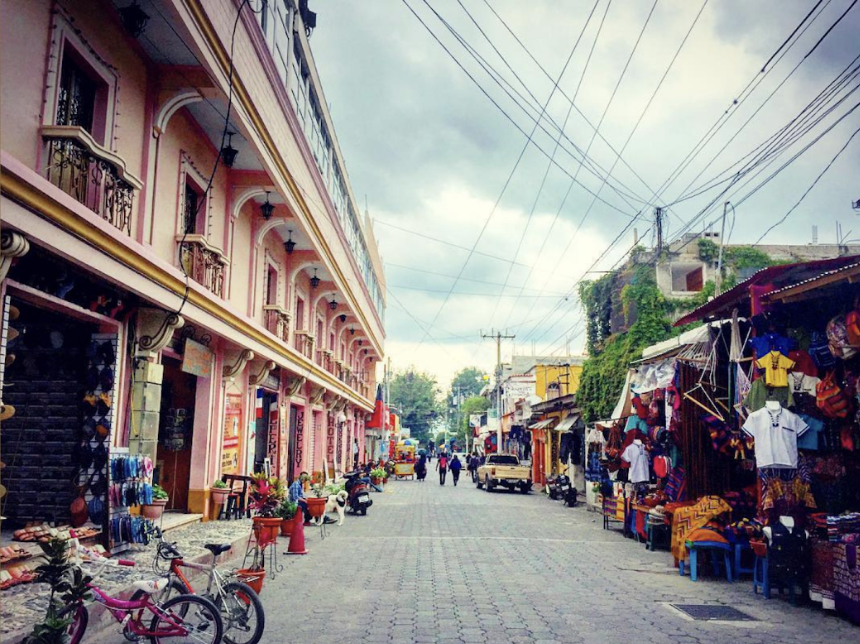
We begin to walk up a paved road with colorful tiendas whose signs and advertisements are painted directly on the walls. Lorenzo tells me that it is only recent that the roads are paved and electricity is standard as a result of the ever-growing gringo population. I can tell he isn’t too happy about it, however he presents this information with an air of ‘thus is life’. We stop abruptly for him to get his machete. “Dos minutos” he tells me, and disappears down a dirt path. I settle in for the estimated 2 minutes of downtime. Yet 30 seconds later, he’s back. Like a gazelle.
We pass 2 gringos with floppy hats and walking sticks (definitely Canadian) and continue on. It’s 9:15 am. I won’t see another white person (with the exception of a questionable and random 14-year old Jehovah’s Witness in another pueblo) until 2:00 pm, when the tour ends.
Lorenzo gives me a loose rundown of the day ahead. We are going to climb to the top of the mountain to see some very-traditional Maya villages. Great! Some exercise, some nature, some National Geographic-style photo ops. I’m excited for our adventure, and we hunker on.
When I say we hiked to the top of the mountain, I am not exaggerating in the least. Again, an avid hiker I am not. This is apparent from my choice of garb. Semi-athletic I am. Until now, a combination of boxing and boot camp classes have been the most physically and mentally challenging ‘deportes’ I’ve attempted. I had NO IDEA that Barry’s Boot Camp would seem like a cakewalk after today.
Lorenzo and I begin our ascent over rocks, through shrubbery, over schools of buzzing bees sucking the life out of broken fruits. It dawns on me (now) that shorts weren’t a really good idea. Thankful for his first aid kit, I shrug and carry on. Within 20 minutes I am panting like a dog and sweat is starting to drip down my face. It’s not too hot, but it is humid, even by Miami standards where I have lived for nearly a decade. Each step we take is a bit more intense than the last. More vertical, one might say. Lorenzo is asking me questions, and I begin to doubt that I have the oxygenic capacity to answer them. Questions begin to flood my mind: Should I be worried about altitude? Poisonous plants? Rapid mountain lions? Did I eat enough? Did I drink enough? The varying answers to these questions convince me that I am FAR from prepared for this hike, and it has only just begun.
Thirty minutes later, Lorenzo casually suggests we take a rest on a rock that overlooks the lake. Which is a good thing. At this point, I’m drenched with sweat. Both of my shirts are soaked through, I can squeeze my tiny bun and a fountain of liquid literally cascades onto my neck and shoulders. Lorenzo is a little damp, but nothing noticeable. The sweat of a light jog, nothing more. As I’m shamefully laughing (inwardly) at myself, he points out the various towns around the lake. The view is truly stunning. Marvelous. All-encompassing. My pride for making it this far is bursting from my orifices. We sit, I feel a bit lightheaded. If there is one thing I am usually prepared with, it’s food, so I quickly grab two leftover breakfast tortillas from my sack and offer one to Lorenzo. He takes it, and we take in the scenery and munch. Then, he turns around behind us and points to a miniscule white structure at the tippy top of the mountain. It looks like a Lego house from where we are sitting. It also looks to be perched at a complete 90 degree angle. “Seguimos alla.”
Yes, readers, Lorenzo has just informed me that we will continue to that house. That we are ALMOST halfway to our destination. That there are two routes we can take, one completely vertical, harder, yet shorter; another that is longer, ‘mas suave’, and has better scenery. Even though I am usually up for a good physical challenge, I do know my limits. I humbly opt for the second route, take a deep breath and continue in the direction of the clouds with Lorenzo.
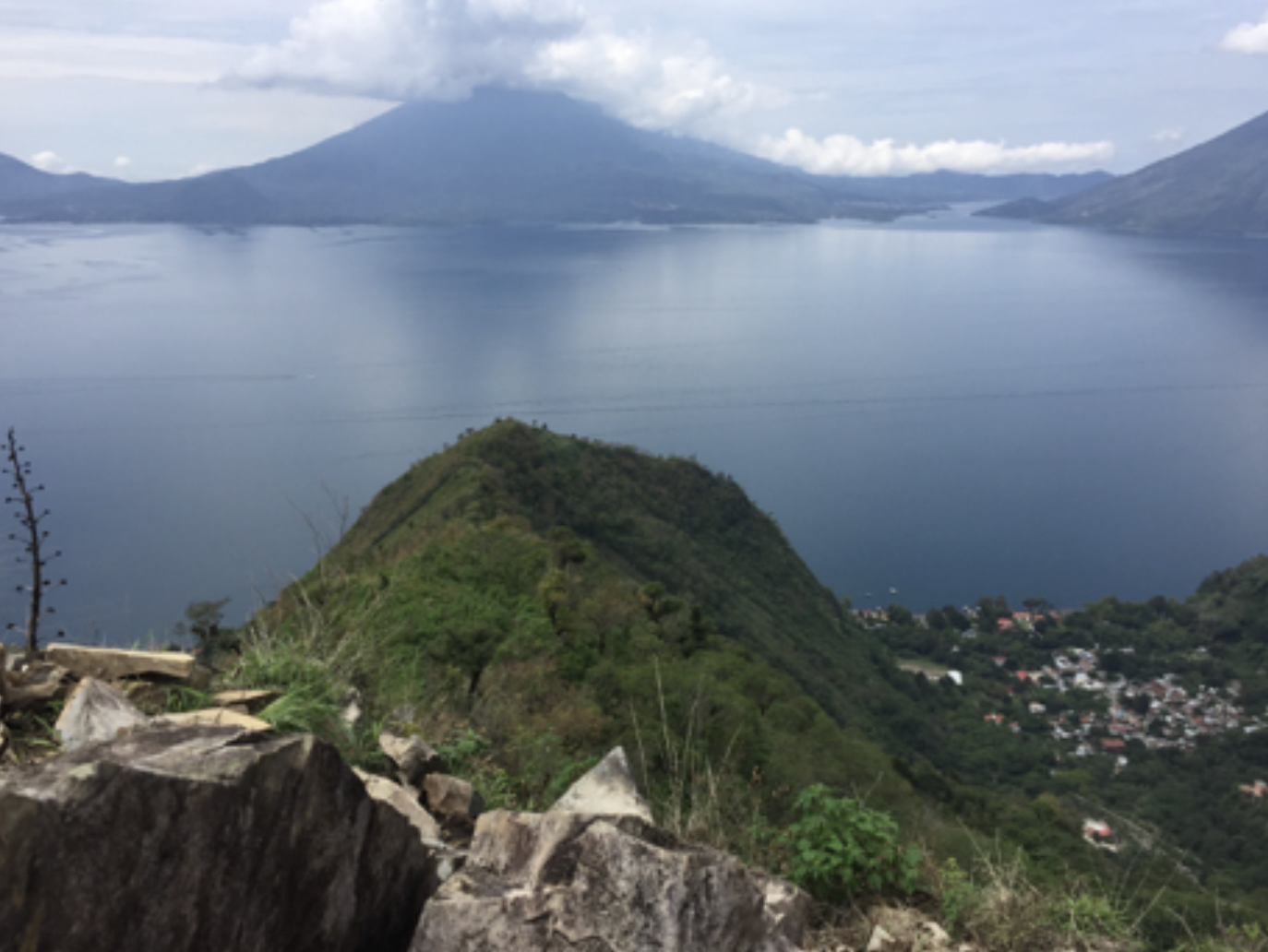
Brief Stop #1 (To the right is the pueblo where we started).
And boy do we continue. Up and over slippery rocks, along legit cliffs, through brush, past sheep, pigs, and cows. Through cornfields to avoid the cows, as Lorenzo seems a bit uneasy to get too close. Wait, are cows dangerous? (Later research indicates that cows do have an aggressive streak in the most particular of circumstances and are not to be provoked.) He holds my hand on several occasions to jump over crags. We stop twice more to take in the views, I take some pictures, contemplate if I’ve done enough of what I wanted to do in life should I happen to lose consciousness from lack of food energy and altitude and fall down one of these cliffs (The answer is twofold, and that’s for another blog post). After what seems like a day, but is actually about 1.5-2 hours, we reach our destination.
Up to this point in my life, this hike might be the hardest thing I’ve ever done. Mentally and physically exhausted, I have also never been prouder of a physical feat. The cool air at the top of the mountain is reward enough, but to have the ability to look down over this jaw-dropping landscape is a feeling unmatched by few others. The town where we started, Jaibalito, resembles pointillism. I cannot believe I did that, and I tell him so. Inolvidable. Unforgettable.
What’s better? The end of this experience is nowhere in sight!
We meander into the first pueblo. There are flimsy shacks, Maya men and women, kids, sheep, and dogs. About two tiendas, one school. In a tienda, I offer Lorenzo a treat. We buy out the shop (exaggeration), since my smallest bill is 20 quetzales (almost $3) and the cashier doesn’t have change. Together we sit on the terrace with two sodas (the pickins’ were slim), two bags of chips, and a huge, colorful piece of cake that Lorenzo eats and I pine for, but won’t risk the ‘street food’ due to the possibility of a gastrointestinal reaction.
Lorenzo tells me about life, about his crazy ex-girlfriend, about the pueblo and the people. It’s so small, this village, and most people laboriously trek up and down the mountain each day to work the fields. What impresses me the most about this place is the sound. A perfect mixture of latin music, men grunting, tools clanging, children laughing, sheep baahing, dogs barking. Lorenzo loves this town, and feels that it’s the perfect, simple life. Life in Jaibalito is becoming too modern, and the younger generation is losing interest in tradition. The teens are potheads, and it’s leading to violence. He teaches me how to say thank you in the local language, a jolty collection of syllables that make up a word I forget in a nanosecond. We finish our sodas and move on to the next leg of our journey.
We walk a paved road to the next town, possibly called San Pedro, of Sololá. Lorenzo points out a traditional house along the way, made with mud. Cement was introduced by the gringos within the last 30 years, no one had heard of it before. He notes that people are speaking more Spanish, and less k’iche, the local language, than when he was young. We chat about the difficulty in holding on to tradition in these modern times until we come to the town’s main square. It is completely full of kids in school uniforms, women in colorful Maya dress, 20 somethings on scooters, and stray dogs. There is color everywhere. Fields of fragrant ripe onions. Shops selling anything from tortillas to cell phones. Ladies offering fresh fruits covered in bees and water ice in plastic cups. We stop to use the restroom, and while I wait for Lorenzo, three adorable, school age girls approach me with big smiles. One, the chattiest girl of the bunch, is in Maya dress. The other two are in uniform. They nervously begin to speak to me in Spanish and are thrilled when I respond. They tell me about the basketball game going on beside us, it is a match played by their teachers. Students are sitting, cheering, eating water ice as the game goes on. The girls are so beautiful, I want to hug them and hang out with them, but I hesitate to be too affectionate, as it is rumored that Maya parents are wary of gringos kidnapping their children. I simply don’t have the language capacity to explain that children are the last thing I need at this moment in my life. Lorenzo returns, I say ciao, and the girls run away giggling.
The next part of our adventure tops the list of greatest, most immersive things I’ve ever done. I knew we were planning to take a taxi to the next town, but I didn’t know which kind. Tuk Tuks are everywhere, so I sort of assumed that would be our mode of transportation. It was not. Lorenzo heads to the window of an old-school red pick-up truck with bright blue racks on the back, turns to me and smiles, and hops in the bed. I hop on too and go to sit down for safety reasons. He remains standing, and feeling dumb, I follow suit. Another man jumps in and the truck revs its engine. Thus commences a thrilling ride, Guatemalan-style, through the hills, plains, towns, and fields of the countryside. We roll through winding roads, stopping to pick people up along the way. A very old Maya woman with little to no teeth in traditional costume with a pack on her head and another in her hand gets on. I catch a glimpse inside one of the packs, it’s full of corn. She doesn’t seem to notice or care that I’m less than local. All she cares about is getting where she wants to go. Perfect.
Everything we pass amazes me. Families of three on tiny scooters. Men washing their shirts in drain ditches on the side of the road. Women balancing heavy packs on their heads, strolling along the road, probably also full of corn and grains and onions and lettuce. In the backdrop are immense, rolling hills and foggy mountain peaks. The roads are a combination of dirt and pavement, some with speed bumps and others potholes. The emotion of this experience is taking over my already-dramatic personality and tears start to form in the corners of my eyes.
The greenery subsides as we come to a very crowded town. I would almost call it a city. It is Solola, the main hub of the province. SO MANY PEOPLE are walking, talking, eating, shopping. The traffic is insane, but I love it because it slows the truck down and gives me the opportunity to visually collect more detail. Every street corner boasts a food vendor of sorts. The people are a mixture of very traditional and very modern, yet they are all interacting just the same. We arrive to a gas station and get out to go to the market. As you can imagine, not only is it full of people, it’s full of items ranging from lace panties to indigenous dresses, papayas to live crabs, piñatas, and absolutely everything in between. It reminds me of a North African souk. Upon exiting, Lorenzo asks if I want to buy anything. I don’t, but even if I did, it’s a little late now, no? He doesn’t like this city, I can tell it makes him nervous. I ask him so, and he confirms. It isn’t his thing.
We walk through the square to a shiny gold and emerald painted chicken bus. A chicken bus is an old, American school bus that has been pimped out with a glamorous paint job, brightly colored seats, neon, digital signs indicating its destination, and a flat screen t.v. playing music videos (in today’s case, a live concert in Mexico). Lorenzo tells me we are taking it to Panajachel. I happily get on. We each get a (very cushiony and comfortable) seat with a neighbor. Lorenzo sits behind me. There is a guy, the money collector and organizer, who is screaming unintelligible Spanish commands to the riders of the chicken bus. He climbs on top, then into the bus, until everyone is on. Waaaayyyyyy past capacity, I am absolutely loving it. A man with a cowboy hat squeezes up and down the aisle selling ice cream cones, and my seat neighbor (a gangster-looking Guatemalan in his 40s) buys a cone with yellow ice cream and devours it in about 5 bites. Fascinating.
The chicken bus begins to roll and off we go. It stops in various places to pack more people on, and I am forced into the middle of the seat (made for 2) to accommodate a new passenger, a man with a baby. I want to smile at the little guy but again, kidnapping. Can’t risk it. I look out the window to incredible vistas of the lake and the mountains, with little towns in between. The locals don’t seem to care about the views like I do.
Thirty-ish minutes later we arrive at Panajachel. Lorenzo offers to take me around but I decide to let him go to do his thing. I want to have lunch and shop and write about this experience. We say our goodbyes and I give him a tip. He asks me not to tell anyone, as he isn’t allowed to take tips. I promise not to say a word, and hope to see him later. He disappears into the crowd like the little fairy sprite that he is.
I pop into a beautiful Yelp-recommended deli with a tree growing right in the center of the seating area. It is full of different-hued chairs and tables, flowers, and lamps shaped like stars. I order a bright purple pitaya smoothie and a delectable avocado sandwich. Panajachel is a mixture of Maya, latinos, and gringos. The gringos, almost all in elephant pants, generally appear as though they haven’t washed their hair in a week. In the deli, half of me is eavesdropping on a conversation between a British girl and Spanish girl bitching about a mutual friend who is obviously very full of herself. The other half is telling myself to focus on my notebook, so I do, and think about what to write.
I start with contemplating the dramatic change of society I have just witnessed. The first village, whose name I don’t know and cannot seem to Google, was one of the more primitive I’ve seen in my travels. Women washed clothes at the bottom of the hill that the town is perched on, because it’s impossible to transport enough water to the top. Electricity was questionable, and people lived alongside sheep. Children didn’t seem to attend school after the age of 12, and the existence of the internet was highly questionable.
The second pueblo was a bit more modern, though not by much by ‘western’ standards. Farmers worked fields adjacent to Photocopy shops, and children's schooling was more organized but not contemporary. The third village was more of a city, with thousands of people standing around the paved streets. There were gas stations and highway street signs indicating direct routes to Guatemala City. Still, traditional Maya and teenagers with earbuds could be seen chatting next to stores blasting Nicky Jam. Panajachel, where I am as I relive all these details, encompasses all of the above, plus gringos. There are street markets, but there are also boutique shops. There are tortilla stands, as well as quaint cafes whipping up organic food and smoothies. There are cars, bikes, motos, and lanchas (water taxis to take you from town to town along the lake).
From north to south, top to bottom, of these magnificent mountains that make up the Lake Atitlan region, it’s possible to retrace and relive the history and culture of Guatemala & its Indigenous population. So much of it is still very present. Sadly, try as they might, tradition is becoming more and more difficult to hold on to. It feels very familiar, the general issues and decisions the entire world is facing right now. Should we, as a people of earth, throw in the towel and unite as one? Mix and match cultures, skin tones, beliefs, and languages? Or should we go back to our roots, and find a way to preserve what we have been for so many years? It’s hard to say, and even harder to comprehend. Guatemala showed me that, in just one day.
And maybe that’s why this was one of the most memorable days of my life.