
Europe’s Border Chaos May Be Doing What Overtourism Campaigners Couldn’t
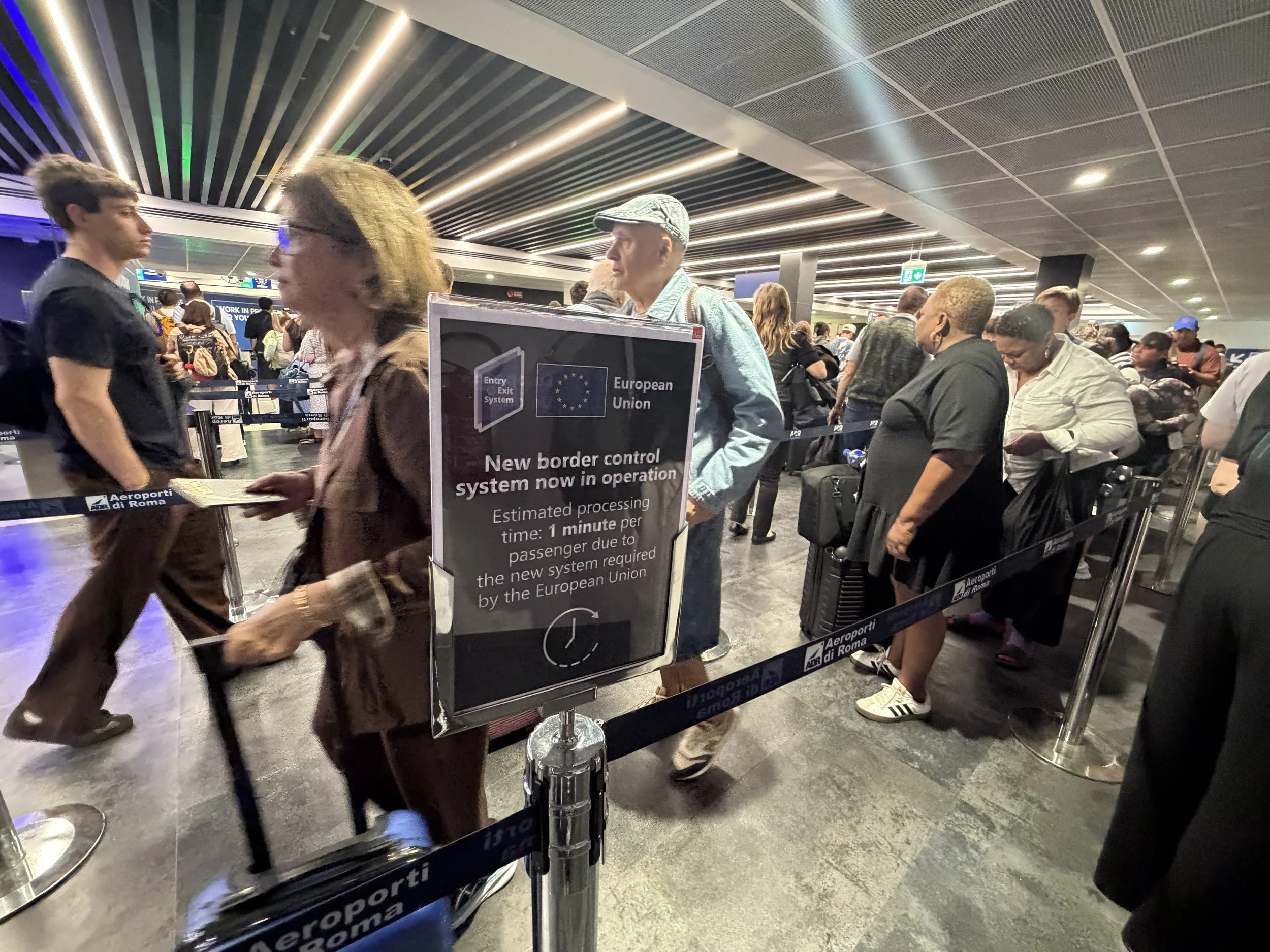
Travellers in long queues at Fiumicino airport near Rome on Sunday morning. Photo: M Bociurkiw
Two-hour airport queues, empty transatlantic seats and unusually cheap summer fares: Europe’s troubled new border system is becoming a test of both traveller patience and Brussels competence
ROME — There are few better ways to begin a European summer holiday than standing in an immigration queue for two hours.
Arriving in Rome this weekend, I encountered impossibly long lines at passport control, particularly for travellers whose passports could not be processed through the automated gates. At the peak of the summer travel season, hundreds of passengers were funnelled toward traditional border booths, with some appearing likely to wait two hours or more before officially entering Europe.
The experience was not merely an airport inconvenience. It was a vivid, ground-level illustration of a much bigger problem now confronting the European Union.
After eight years of development, the EU’s flagship Entry/Exit System, or EES, is causing enough concern that Brussels is launching new talks with member governments in an effort to prevent border delays from disrupting summer travel.
The system, introduced gradually from October 2025 and made mandatory for short-stay non-EU travellers entering the Schengen zone from April 10, replaces traditional passport stamps with the collection of fingerprints and facial images.
In theory, it is a modern security system designed to identify overstayers, fraudulent documents and travellers who do not meet entry requirements.
In practice, at some of Europe’s busiest entry points, it has become another queue.
And for Brussels, another credibility problem.
EU Migration Commissioner Magnus Brunner insists the EES works well in most member states and airports. But in a letter to aviation industry leaders, he acknowledged longer waiting times at some destinations and cited insufficient staffing and inadequate infrastructure among the causes.
European Commission President Ursula von der Leyen has now also acknowledged “technical problems” requiring significant work.
This is not a good look for a bloc that prides itself on administrative competence, technological sophistication and frictionless movement.
Yes, national governments are responsible for implementing the system. Yes, staffing and airport infrastructure vary widely from one country to another. But Brussels designed the framework, oversaw years of preparation and is now intervening because the problems are serious enough to alarm airlines and airport operators.
For travellers, distinctions over which level of government is technically responsible are largely irrelevant. They see one thing: Europe introduced a new border system and the result, in some places, is chaos.
The timing could hardly be worse.
Europe is already battling a difficult summer tourism environment. Persistent heat waves are making traditional July and August city breaks less attractive. Economic pressures are forcing some households to reconsider expensive long-haul holidays. Others appear to be travelling closer to home.
And then there are the airport horror stories.
Before flying to Rome, I noticed something highly unusual: remarkably low fares from Toronto to the Italian capital on Air Canada. On the transatlantic flight itself, there were empty seats — a sight that is hardly typical during the peak European summer season.
It would be too simplistic to blame Europe’s border problems alone for softer demand. Airfares are influenced by capacity, competition, economic confidence and many other factors. But traveller psychology matters too.
If potential visitors repeatedly see stories about multi-hour airport queues, record-breaking heat and overcrowded European cities, some will inevitably reconsider.
The irony is that Europe’s border problems may be accomplishing something years of anti-overtourism campaigns struggled to achieve: discouraging visitors.
Cities from Barcelona to Venice, Lisbon and Dubrovnik have spent years grappling with the consequences of excessive tourism — packed historic centres, overwhelmed infrastructure and local resentment over housing being converted into short-term accommodation.
If fewer travellers are willing to endure expensive flights, extreme heat and a two-hour welcome at passport control, some of those cities may receive an accidental reprieve.
That would be an extraordinary unintended consequence: bureaucratic dysfunction acting as tourism management.
To be fair, the EES is producing results. According to figures provided to POLITICO, 43,728 people have been refused entry to the EU since October 2025. More than 16,000 reportedly lacked sufficient justification for entry, almost 9,000 would have exceeded permitted stay limits and more than 400 were allegedly travelling with counterfeit documents.
Those are significant numbers, and secure borders matter.
But security and competence are not mutually exclusive. A system developed over eight years should be capable of identifying problematic travellers without subjecting vast numbers of legitimate visitors to punishing waits.
Europe has been here before.
During the COVID-19 pandemic, travellers watched EU member states impose a confusing patchwork of changing entry rules, testing requirements, quarantine regimes and vaccine documentation. Coordination often appeared to come after confusion rather than before it.
And the fragmentation continues. Unilateral border checks within Europe’s supposedly border-free Schengen Area have continued to expand, with nine countries — including France, Germany, Austria and Denmark — maintaining or extending internal controls in response to migration and security concerns. The European Commission has urged governments to remove the checks, but many appear determined to keep them.
The symbolism is difficult to ignore: even as Brussels introduces an ambitious new system to control Europe’s external borders, national governments are rebuilding barriers within them.
The EES rollout risks reinforcing that same impression: an enormously ambitious European project whose practical consequences were not adequately anticipated before ordinary people were forced to navigate them.
For Brussels, that is the larger danger.
The EU is already struggling with scepticism about whether its institutions are responsive, efficient and connected to the realities experienced by citizens and visitors. Every traveller trapped in a seemingly endless immigration queue becomes an unwilling participant in that debate.
And unlike a policy paper or a Commission press conference, a two-hour airport queue is something people remember.
Europe still has time to fix this summer’s border mess. Member states can temporarily suspend biometric collection when queues become unmanageable, and the Commission says it will work directly with governments still experiencing serious problems.
But the question travellers are entitled to ask is a simple one:
After eight years of preparation, why is Europe trying to solve this problem now — when the queues are already here?